
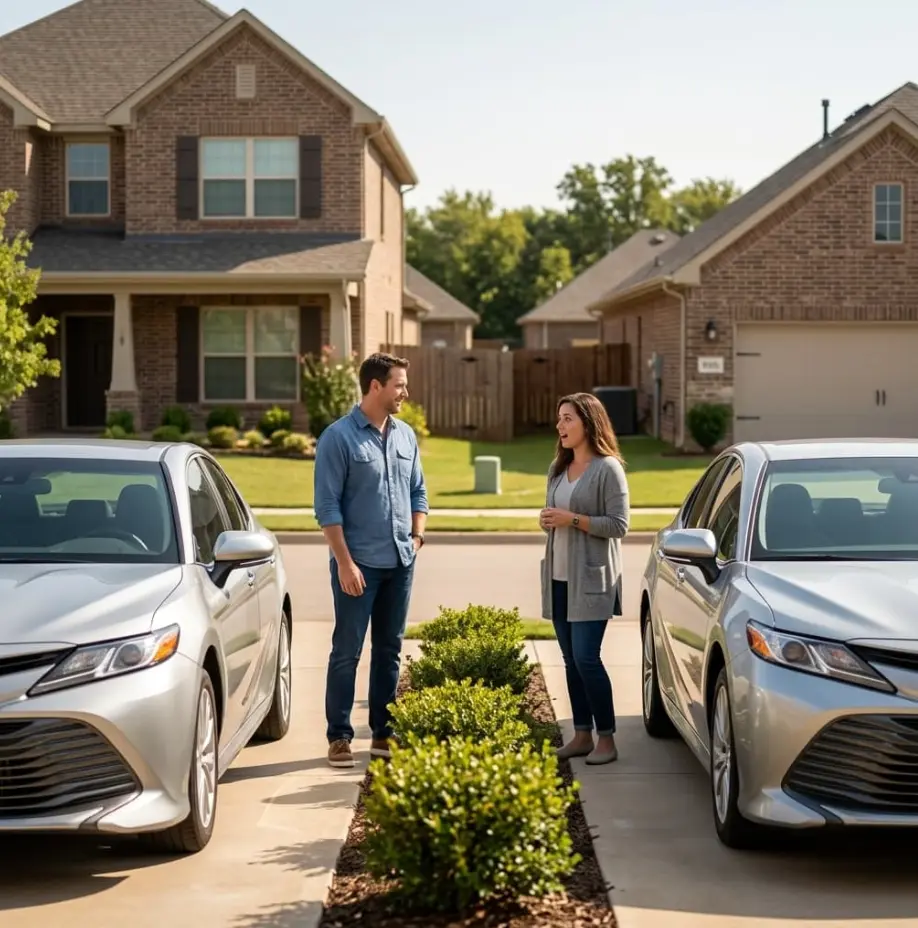
Here is the short answer: your neighbor pays less because insurance companies don't price the car — they price the driver, the household, and the risk behind the wheel. Two people can own the exact same year, make, and model, park them in driveways twenty feet apart, and still receive quotes that differ by hundreds of dollars a year. Nothing about that is a mistake, and nothing about it means you're stuck with the higher number.
It's one of the most common questions we hear at Cheapest Auto Insurance, usually phrased almost exactly this way: we drive the same car, so why am I paying more? Once you understand which factors carriers actually weigh — and how differently each company weighs them — comparing quotes stops feeling like guesswork. If you're shopping for the cheapest car insurance, knowing why these gaps exist is what lets you close the one you're on the wrong side of.
Your Vehicle Is Only One Piece of the Quote
Many drivers assume the vehicle is the biggest factor in what they pay. It matters — repair costs, theft rates, and safety ratings all feed into a rate — but it's only one input among many.
Before producing a quote, insurers typically evaluate a combination of factors:
- Your driving history
- Your age and driving experience
- Where you live
- Your insurance history
- How your vehicle is used
- The coverages and limits you select
- The discounts you qualify for
Look at that list together and the mystery dissolves. Two people driving the exact same vehicle can differ on six of those seven lines. The Insurance Information Institute notes that insurers use proprietary rating formulas built from their own claims data, which is why the same driver profile produces different prices at different companies — and why the vehicle alone was never going to settle the question. Our guide to what actually determines your car insurance premium breaks these inputs down one at a time.
Your Driving History Can Outweigh Your Vehicle Entirely
Imagine two neighbors who both drive a 2022 Honda Accord. One has held a clean record for several years. The other picked up a speeding ticket last spring, or was at fault in a minor collision. The cars are identical. The premiums are not.
Insurance companies review moving violations, at-fault accidents, previous claims, and — critically — how recently those incidents occurred. Recency carries real weight, because a violation from four years ago predicts far less than one from four months ago. Most incidents fade from your rate over time rather than disappearing overnight, a timeline we walk through in how long accidents stay on your record.
Here's the part most drivers miss: not every insurer treats these events the same way. One company may effectively forgive an older ticket while another still surcharges for it. That single difference in philosophy is why two quotes for the same driver can land so far apart.
Consider how a realistic side-by-side actually breaks down. Both neighbors drive a 2022 Honda Accord, but:
- Driving record — your neighbor's is clean; you have one recent speeding ticket.
- Insurance history — your neighbor has five continuous years; you had a recent coverage lapse.
- Annual mileage — your neighbor drives 6,000 miles a year; you drive 15,000.
- Discounts — your neighbor stacks multi-vehicle and auto pay; you have auto pay only.
- Insurance company — your neighbor is with Company A; you're with Company B.
Result: a lower premium for your neighbor, a higher one for you — and the vehicle explained none of it. Every meaningful difference sits on the other five lines. If a ticket is what's driving your number, our breakdown of rates after a speeding ticket shows how much room there usually is to recover.
Your Insurance History Matters More Than Most Drivers Realize
Insurance history is the single most overlooked pricing factor we see, and it's the one that surprises people most.
Suppose two neighbors have similar vehicles and similar driving records. One has carried continuous auto insurance for five years. The other let a policy lapse for a few weeks before buying a new one. They now need identical coverage — and they will very likely not be offered identical premiums.
Insurers commonly weigh:
- Whether your coverage has been continuous
- Any recent lapses, even brief ones
- The length of your prior insurance history
- How long you stayed with previous companies
A lapse reads as risk, even when the cause was mundane — a missed payment, a car sold between policies, a move that scrambled the mail. Because each company builds its own pricing model, the penalty for that lapse varies enormously from one insurer to the next. That's precisely why re-shopping after a gap tends to pay off. Our guide to what a car insurance lapse really costs covers how long the effect lingers and how to keep it from repeating.
Living on the Same Street Doesn't Guarantee the Same Rate
Sharing a ZIP code feels like it should mean sharing a rate. It doesn't, because location is where an insurer starts, not where it stops.
Beyond your address, carriers also consider:
- Annual mileage
- Your daily commute
- Other drivers in the household
- Where the vehicle is typically parked overnight
- How frequently the vehicle is driven
One neighbor may work from home and put a few thousand miles on the odometer each year. The other commutes across Tulsa every weekday, twice a day, through the exact rush-hour traffic where most collisions happen. They live next door to each other and their driving lives have almost nothing in common. Mileage alone is a genuine lever you control, as we explain in how annual mileage affects your premium — and low-mileage drivers are often the best candidates for usage-based and telematics programs. Within a metro, block-level differences matter too, which is why rates shift across Oklahoma City neighborhoods.
Discounts Explain a Bigger Share of the Gap Than You'd Think
Discounts are the quietest reason one driveway pays less than the other. Depending on the insurer, one household may qualify for savings the household next door never even hears about.
Common examples include:
- Multi-vehicle discounts
- Renters or homeowners bundle discounts
- Automatic payment discounts
- Paperless billing discounts
- Defensive driving discounts
- Military discounts
- First responder discounts
- Good driving discounts
Individually, these look small — a few dollars here, a percentage point there. Stacked, they routinely move a premium more than switching to a thinner policy would, and without giving up any protection. That's the trade every driver should want: a lower total, identical coverage. Many Oklahoma drivers are genuinely surprised by the discounts they already qualify for, and our guide to stacking discounts the right way shows how to combine them deliberately rather than by accident.
Every Insurance Company Calculates Rates Differently
The most damaging misconception in car insurance is that every company charges roughly the same price, so shopping around is a waste of an afternoon.
In reality, each carrier develops its own method for evaluating risk. One company competes hard for drivers with years of continuous coverage. Another prices more forgivingly for a newer driving history. Some lean heavily on driving experience; others put more weight on annual mileage, insurance history, or the discounts you bring with you. These are proprietary rating formulas, and they genuinely disagree with each other.
Which means your neighbor may not be a better risk than you at all. They may simply be insured through the company whose formula happens to like their profile. Finding the company whose formula likes yours is the entire game — and it's why we compare multiple standard and nonstandard carriers in a single pass rather than quoting one company and calling it a market. Drivers with a ticket, a lapse, or a short insurance history benefit most from that spread, because those are exactly the profiles where carriers disagree the most.
What to Do If You're Paying More Than Your Neighbor
If you've just discovered you're paying more than someone with a similar vehicle, don't assume the premium is fixed. Review the information being used to calculate it — much of it may be out of date.
Ask yourself:
- Has my driving record improved since I bought this policy?
- Am I driving fewer miles than I used to?
- Have I recently moved or changed jobs?
- Have I asked about every available discount?
- When was the last time I actually compared quotes?
- Has anything changed in my household — a marriage, a new driver, a vehicle sold?
Each of those is a rating factor, and each one drifts over time. A rate set three years ago may be priced for a driver who no longer exists. This is also the quiet reason premiums sometimes rise with no accident on file, which we unpack in why your rate went up without a claim. Small life changes move premiums, so reviewing your policy on a schedule is one of the highest-return habits in personal finance.
The Cheapest Car Insurance Depends on Your Situation
People search online hoping to find the one company that is always the cheapest. It doesn't exist. The insurer offering your neighbor the lowest premium may not be the one that offers you the best rate — because your driving history, insurance history, mileage, household, vehicle usage, and available discounts are yours alone.
That's why comparing quotes based on your own information is the single most effective way to find affordable coverage, and why we put together a checklist for comparing quotes the right way. If you want to see how profiles diverge across the state, who has the cheapest car insurance in Oklahoma sorts it by city and driver type.
The next time someone tells you they pay less for the same vehicle, remember their premium isn't a benchmark for yours. Insurance companies evaluate every driver differently, and the cheapest car insurance was never determined by the car alone. Understanding how those rating factors work — and comparing quotes against your own driving profile — puts you in a far better position to find a competitive rate.
Compare Your Own Rate in About a Minute
You can't rate yourself the way your neighbor's insurer rates them, but you can find the company whose formula fits your profile. Cheapest Auto Insurance is a local Tulsa agency that shops multiple carriers to find your lowest rate on car insurance in Oklahoma — one conversation, every carrier we shop, no pressure.
Start your free quote online in about a minute, or call or text a local agent at (800) 988-3794.
Preguntas frecuentes
Why does my neighbor pay less for car insurance if we drive the same car?
Insurance companies consider much more than the vehicle you drive. Your driving history, insurance history, annual mileage, household information, available discounts, and the insurance company itself can all affect your premium.
Does driving the same vehicle mean insurance should cost the same?
No. While the vehicle is an important rating factor, insurance companies also evaluate the driver, how the vehicle is used, where it's garaged, and the coverages selected. Two people with identical vehicles can receive different premiums.
Can switching insurance companies help me find cheaper car insurance?
It can. Every insurance company uses its own pricing model, so comparing quotes from multiple companies may help you find a more competitive premium for your situation.
Why do insurance quotes vary so much between companies?
Insurance companies weigh risk differently. One company may place more emphasis on driving history, while another may focus more heavily on insurance history, mileage, or available discounts.
Does continuous insurance affect my premium?
Some insurance companies consider your insurance history when determining rates. Maintaining continuous coverage may help you qualify for more favorable pricing with certain insurers, although every company evaluates applicants differently.
How often should I compare car insurance quotes?
Review your policy at least once a year or after major life events such as moving, purchasing another vehicle, changing jobs, getting married, or significantly changing your annual mileage. Keeping your policy up to date can help ensure you're receiving all available discounts and paying a competitive rate.