
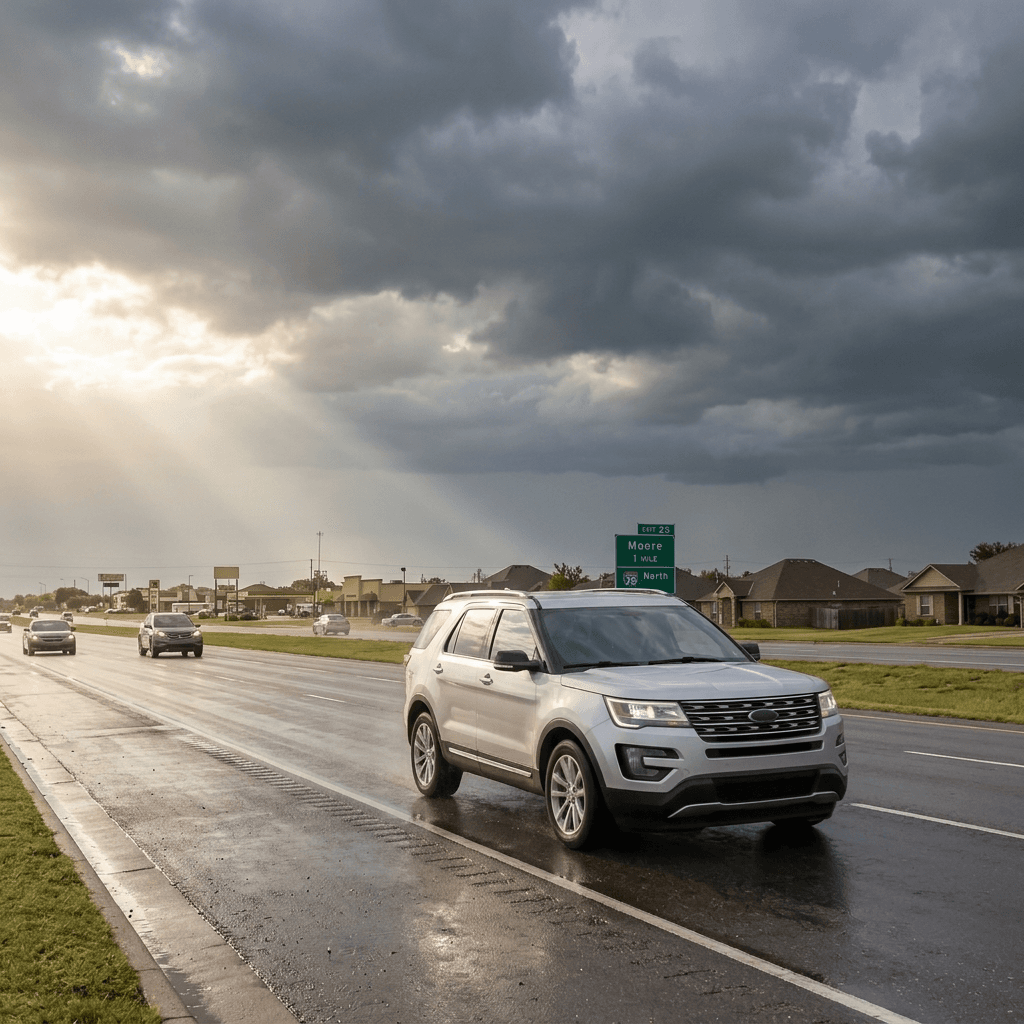
Car insurance in Moore is priced around one fact most rate guides ignore: Moore sits in the most active stretch of Tornado Alley in the country. Two EF5 tornadoes and a steady run of spring hailstorms have made this I-35 suburb between Oklahoma City and Norman one of the most weather-claimed ZIP code clusters in Oklahoma. That history doesn’t just live in the news — it lives in your premium, and especially in the part of your policy most drivers treat as an afterthought.
If you live in 73160 or 73170, the smartest money move in Moore usually isn’t switching brands. It’s understanding how hail, comprehensive coverage, deductibles, and total losses interact, then building a policy around the storm season you already know is coming. Here’s what Moore drivers actually pay, and where the real savings hide.
Why Moore sits in a different risk box than the rest of the OKC metro
Moore is technically part of the Oklahoma City metro, but insurers don’t rate it like inner OKC. They rate it by its own claim history — and Moore’s claim history is dominated by weather, not crime or congestion. The town straddles the I-35 corridor in Cleveland County, takes the brunt of supercells rolling up from the southwest, and has been hit directly by catastrophic tornadoes in 1999 and 2013. Even in calm years, the hail that falls here turns into comprehensive claims at a rate that quieter Oklahoma towns never see.
That puts Moore in a different bucket than a low-claim suburb, even though its drivers, roads, and commute look ordinary. The statewide forces behind this are laid out in our look at why insurers watch Oklahoma weather so closely, and the metro-level picture in our Oklahoma City rates and coverage breakdown for 2026. Moore shows up by name in our Oklahoma City neighborhood rate comparison for exactly this reason — it prices on its own weather profile, not the metro average.
Hail season is the real rate story in Moore
Most Moore drivers think of car insurance as protection against a crash. Here, it’s just as much protection against the sky. Hail is the quiet, recurring claim that shapes premiums across Cleveland County, and it’s covered under the comprehensive portion of your policy — not collision, and not liability. That distinction matters more in Moore than almost anywhere in the state.
A clear read on comprehensive versus collision coverage is the foundation here: comprehensive pays for hail, wind, flying debris, flood, and a tree limb through your windshield, while collision handles crashes. If you only carry liability — and you understand its limits — a springtime hailstorm that dimples every panel on your car is entirely on you. Our guide to comprehensive storm-damage coverage in Oklahoma walks through exactly what a Moore policy should include before May, and the trade-off between full coverage and liability frames the decision for a car worth protecting.
The expensive mistake is dropping comprehensive to save a few dollars over winter, then getting caught uncovered when the first April supercell arrives. In Moore, comprehensive isn’t the optional part of the policy — it’s the part you bought it for.
The deductible math after an Oklahoma hailstorm
Once you’ve kept comprehensive, the next lever is your deductible — and it behaves differently when hail is the threat. Your comprehensive deductible is what you pay out of pocket before the insurer covers hail repair. Pick a high deductible to shave the premium, and a moderate hail claim can fall almost entirely on you; pick a low one, and you pay more every month for damage that may not come.
We break down this exact trade-off, with Oklahoma numbers, in our $500 vs. $1,000 deductible guide for OKC-area drivers, and the broader mechanics in how car insurance deductibles work. For a Moore driver, the honest question is: if hail does $2,500 of damage this spring — a routine figure here — which deductible leaves you better off across a full season? Drivers who barely ever claim may win with a higher deductible; those who expect to use comprehensive every couple of years often don’t.
One Moore-specific tip: ask whether your policy includes full glass coverage or a separate, lower glass deductible. Windshields are the most common hail and road-debris casualty on I-35, and many Oklahoma insurers will repair a chip with little or no out-of-pocket cost — which keeps a small crack from becoming a full replacement.
When a tornado or hail event totals your car
Moore drivers have to plan for the outcome other towns rarely face: a total loss. When hail or a tornado damages a vehicle beyond a repair threshold, the insurer “totals” it and pays out its actual cash value — what the car was worth the moment before the storm, not what you owe on it. For anyone with a loan or lease, that gap is where a bad week becomes a financial problem.
This is exactly what gap insurance is built for: if you owe more than the car’s depreciated value, gap coverage pays the difference so a totaled car doesn’t leave you paying for a vehicle you no longer have. Because depreciation drives the payout, how new versus used cars are valued and insured directly affects what you’d collect after a Moore storm. Before you ever need to use any of it, learning to read your declarations page tells you in advance whether your coverage actually matches your loan — long before a claims adjuster does.
The I-35 commute between OKC and Norman
Weather is Moore’s headline risk, but the daily one is the road. Moore is a commuter town wedged between two job centers, and a huge share of residents drive I-35 north to Oklahoma City or south to Norman every day. That mileage and that congestion both feed your rate, because more time on a busy interstate means more exposure to the rear-end collisions and stop-and-go fender-benders that drive up claims.
If your commute is heavy, the link between how many miles you drive and your premium works against you — but it can be turned around. A usage-based telematics program rewards smooth, careful interstate driving, and if you actually drive less than the average commuter — remote work, a short hop to a nearby job — pay-per-mile insurance can price that honestly. The flip side is just as real: a single at-fault wreck on I-35 follows you, and our look at how long accidents stay on your record shows how long that one bad commute can cost you.
Moore ZIP codes and the garaging-address question (73160 vs. 73170)
Insurers don’t rate “Moore” as a single place — they rate your specific ZIP. A car garaged in 73160 can be priced differently than one in 73170, because the model weighs local hail and tornado claim frequency, theft and vandalism, repair costs, and how many uninsured drivers share your streets. Two neighbors with identical cars and clean records can land on different premiums for that reason alone.
That’s why “the cheapest company in Moore” is the wrong question — there’s only the cheapest company for your address, your car, and your record. Give the insurer your accurate garaging address; shaving it to a lower-rated ZIP can void a claim when you need it most. Two factors Moore drivers underestimate are your credit-based insurance score and how a quote can move after underwriting reviews your application — both can shift your premium more than swapping brands.
Filing weather claims the smart way — and knowing when not to
In a heavy hail year, plenty of Moore drivers file a comprehensive claim, and that’s exactly what the coverage is for. But not every ding is worth a claim, and knowing the difference protects both your wallet and your record. Our walkthrough of how to file a claim covers the documentation an adjuster wants after a storm, while whether to file a small claim at all helps you weigh a minor repair against a possible rate bump.
The general rule for Moore: a catastrophic hail or tornado event that totals or seriously damages your car is squarely what comprehensive is for — file it. A single cosmetic dent that costs less than (or barely more than) your deductible usually isn’t worth opening a claim. Weather claims are treated differently than at-fault accidents, but a long string of small ones can still nudge your renewal, so save the coverage for the damage that actually matters.
How Moore households actually lower the premium
The cheapest Moore policy isn’t found by chasing the lowest sticker price — it’s built by stacking the right protection with the right discounts. Start with coverage that matches the risk, then layer savings on top:
- Confirm the floor, then build up. Make sure you at least meet Oklahoma’s minimum insurance requirements, but understand why the bare minimum is risky in a town where one storm can total a car.
- Stack every discount you qualify for. Multi-car, bundling, safe driver, and good student add up fast; our guide to stacking discounts in the OKC metro shows how they combine.
- Bundle the home or apartment. Pairing auto with renters or homeowners typically trims both premiums — see how much Oklahoma drivers save by bundling.
- Re-shop on a schedule. Rates drift, especially after a big hail season; here’s how often you should shop car insurance and the full playbook for lowering your premium.
- Match the company to the driver. A young commuter and a settled Cleveland County family need different things; the best Oklahoma companies by driver type narrows the field faster than calling around.
When you’re ready to compare, our Oklahoma quote checklist lists exactly what to have ready, and if a move into Moore is what started this, handling your coverage when you move keeps you from a lapse during the switch.
Moore rewards drivers who treat insurance like the Tornado Alley puzzle it is: keep comprehensive year-round, set a deductible you can actually pay after a hailstorm, close the gap on any loan, garage the car honestly by ZIP, and re-shop after every big spring. Get those right and you’ll be paying a smart Moore rate — one built for the weather you know is coming, not the one you hope skips you.
Get a Car Insurance Quote in Moore, OK
Oklahoma weather can change in a matter of minutes, and the right insurance coverage can make all the difference when it does. Whether you’re buying a new policy or comparing your current coverage, it’s worth taking a few minutes to make sure your insurance is keeping up with your needs.
Cheapest Auto Insurance has been helping Oklahoma drivers find affordable auto insurance since 2006. Get your free online quote today and discover coverage designed to help protect you on the road—and through whatever the next storm season brings.